
Blood Work Series Part 4: Testosterone
Strength. Drive. Resilience. Longevity.
When most people hear “testosterone,” they think muscles and aggression.
That’s a tiny slice of the story.
Testosterone is a foundational hormone for both men and women. It influences how you look, how you perform, how you recover, how you think, and even how you feel about your life.
Let’s break it down in plain English.
Why Testosterone Matters (Men and Women)
1. Lean Mass & Staying Lean
Testosterone:
Increases muscle protein synthesis (your ability to build muscle tissue)
Improves nutrient partitioning (more calories go to muscle, fewer to fat)
Inhibits fat storage indirectly through better insulin sensitivity
More muscle = higher resting metabolic rate.
Higher metabolic rate = easier time staying lean.
Low testosterone?
Harder to build muscle. Easier to accumulate fat. Slower recovery.
2. Training Results in the Gym
Resistance training increases androgen receptor density in muscle tissue. Testosterone binds to those receptors and turns on the machinery that builds muscle.
If levels are optimal:
Strength increases faster
Recovery improves
Adaptation to training is amplified
If levels are low:
You can train hard… and spin your wheels.
3. Mood, Drive & Psychological Impact
Testosterone affects:
Dopamine signaling (motivation and reward)
Confidence and assertiveness
Energy levels
Resilience under stress
Chronically low testosterone is strongly associated with:
Low mood
Brain fog
Irritability
Reduced ambition
Decreased libido
This applies to women as well. Women produce testosterone in smaller amounts, but it still plays a meaningful role in vitality and drive.
4. Fertility & Reproductive Health
In men:
Necessary for sperm production (via stimulation of Sertoli cells)
Supports libido and erectile function
In women:
Supports ovarian function
Plays a role in sexual desire
Influences egg quality indirectly
Testosterone is not “just a male hormone.” It’s a human hormone.
Total Testosterone vs Free Testosterone
When we test testosterone, we usually measure:
Total Testosterone
All testosterone circulating in the bloodstream:
Bound to SHBG (sex hormone binding globulin)
Bound to albumin
Unbound (free)
Free Testosterone
The small fraction not bound to proteins.
Free testosterone is what can actually:
Enter cells
Bind to androgen receptors
Produce physiological effects
You can have normal total testosterone but low free testosterone if SHBG is high.
That’s why we test both.
Why We Test Testosterone in Women (Instead of Estrogen or Progesterone)
Estrogen and progesterone fluctuate dramatically across the menstrual cycle.
Testosterone fluctuates far less.
That makes it:
Easier to interpret
More stable
More clinically useful as a baseline marker
For women, low testosterone can show up as:
Low libido
Low energy
Reduced strength gains
Difficulty building lean mass
And it often goes overlooked.
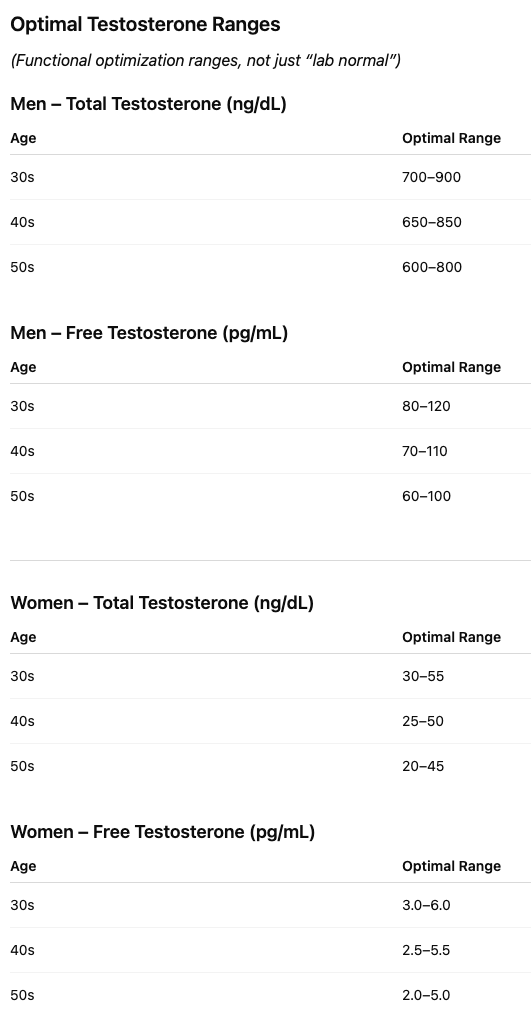
My Recent Results
Total Testosterone: 783 ng/dL
Free Testosterone: 88.7 pg/mL
That places me solidly in an optimized range for my age bracket — not by accident, but by habit design.
Let’s talk about how we influence this naturally.
How to Improve Testosterone Naturally
We always start here before discussing medical intervention.
1. Improve Sleep Quality & Duration
Mechanism:
The majority of daily testosterone release happens during deep sleep.
Sleep restriction can drop testosterone by 10–30% in just one week.
Less sleep → higher cortisol → suppressed gonadal signaling → lower testosterone.
Non-negotiable habit.
2. Train Intelligently
Testosterone responds best to:
Progressive resistance training
Large compound lifts
Moderate training volume
Controlled use of HIIT
Chronic excessive high-intensity training without recovery?
That can elevate cortisol and suppress testosterone.
More is not better. Better is better.
3. Lower Excess Body Fat
Fat tissue contains aromatase — an enzyme that converts testosterone into estrogen.
More body fat → more aromatization → lower usable testosterone.
This is one of the most overlooked drivers of suboptimal levels in men.
4. Match Nutrition to Training
Testosterone production requires:
Adequate protein
Sufficient dietary fat (especially cholesterol as a precursor)
Strategic carbohydrate intake to manage cortisol and support training output
Chronic calorie deficits suppress testosterone.
Under-fueling high output training is a common mistake.
5. Optimize Vitamin D
Vitamin D acts more like a hormone than a vitamin.
Higher Vitamin D levels are correlated with:
Higher total testosterone
Improved androgen receptor sensitivity
Another reason we test and optimize. Check out more on Vit D here.
6. Manage Stress & Cortisol
Cortisol and testosterone have an inverse relationship.
Chronic sympathetic nervous system activation:
Suppresses GnRH (from the brain)
Suppresses LH (from the pituitary)
Reduces testicular testosterone production
Translation:
Live in fight-or-flight long enough, testosterone drops.
Stress management isn’t “soft.”
It’s hormonal optimization.
When Natural Optimization Isn’t Enough
With clients, we:
Fix sleep
Fix training
Improve body composition
Optimize nutrition
Correct Vitamin D
Normalize stress response
We push levels as high as physiology will reasonably allow.
But if:
Symptoms persist
Labs remain suboptimal
Lifestyle is truly dialed in
Then we guide the conversation toward testosterone replacement therapy (TRT).
For the right individual:
It’s safe.
It’s well-studied.
It’s extremely effective.
The key is doing it responsibly, with proper monitoring and physician oversight.
TRT should never be the first step.
But it also shouldn’t be demonized when clinically appropriate.
The Bigger Picture
Testosterone isn’t about vanity.
It’s about:
Strength
Metabolic health
Cognitive sharpness
Drive
Fertility
Longevity
It’s one of the clearest reflections of whether your lifestyle supports your biology — or fights it.
And the good news?
Most of the levers that raise testosterone also improve every other major health marker.
Which is why we test it.
And why we optimize it deliberately.