
The Boring Diet Secret Nobody Wants to Hear
I'm about to say something that will get me uninvited from every foodie dinner party in Colorado.
The people I coach who actually hit their nutritional goals — and keep hitting them, month after month, year after year — eat boring food. Not exclusively. Not miserably. But consistently? Their meals are simple, repetitive, and shockingly unremarkable.
And new research is finally catching up to what I've been watching play out in real time for over a decade.
The Science Just Showed Up to the Party
A study published in Health Psychology this year tracked the food logs of 112 adults enrolled in a structured weight loss program. The researchers measured how repetitive each person's eating patterns were over 12 weeks. The results weren't subtle: people who repeated the same meals lost an average of 5.9% of their body weight, compared to just 4.3% for those who ate a more varied diet. And for every 100-calorie increase in day-to-day fluctuation, weight loss dropped by about 0.6%.
Lead author Charlotte Hagerman put it plainly: routines around eating reduce the burden of constant decision-making and make healthy choices feel more automatic.
That's a researcher's way of saying what I tell my clients all the time: stop making every meal a project.
Why Boring Works (And It's Not What You Think)
Here's what I've seen over and over again with people who sustain real results.
They become ridiculously efficient. When you eat the same handful of meals, meal prep turns from a Sunday afternoon ordeal into a 30-minute autopilot session. You already know the grocery list. You already know the cook times. You're not Googling "healthy dinner ideas" at 5:47 PM with a hungry family staring at you.
They know exactly what they're eating. No guessing on calories. No eyeballing macros. When your Tuesday dinner is the same as last Tuesday's dinner, you already know what's in it. This is the unsexy foundation that makes nutrition tracking actually work — not the fancy app, not the barcode scanner, but the fact that you've already done the math.
They don't accidentally overeat. This one is backed by a well-documented phenomenon in food science called sensory-specific satiety. When you eat the same foods repeatedly, the pleasure response to those foods naturally decreases. Your body says "yep, that was good, I'm done" instead of "ooh, what's next?" Research going back to the early 1980s has shown that food variety actually drives overconsumption — in one classic study, people ate 60% more when offered a four-course meal compared to a single-course meal of the same food. The modern buffet isn't just convenient. It's an overeating machine.
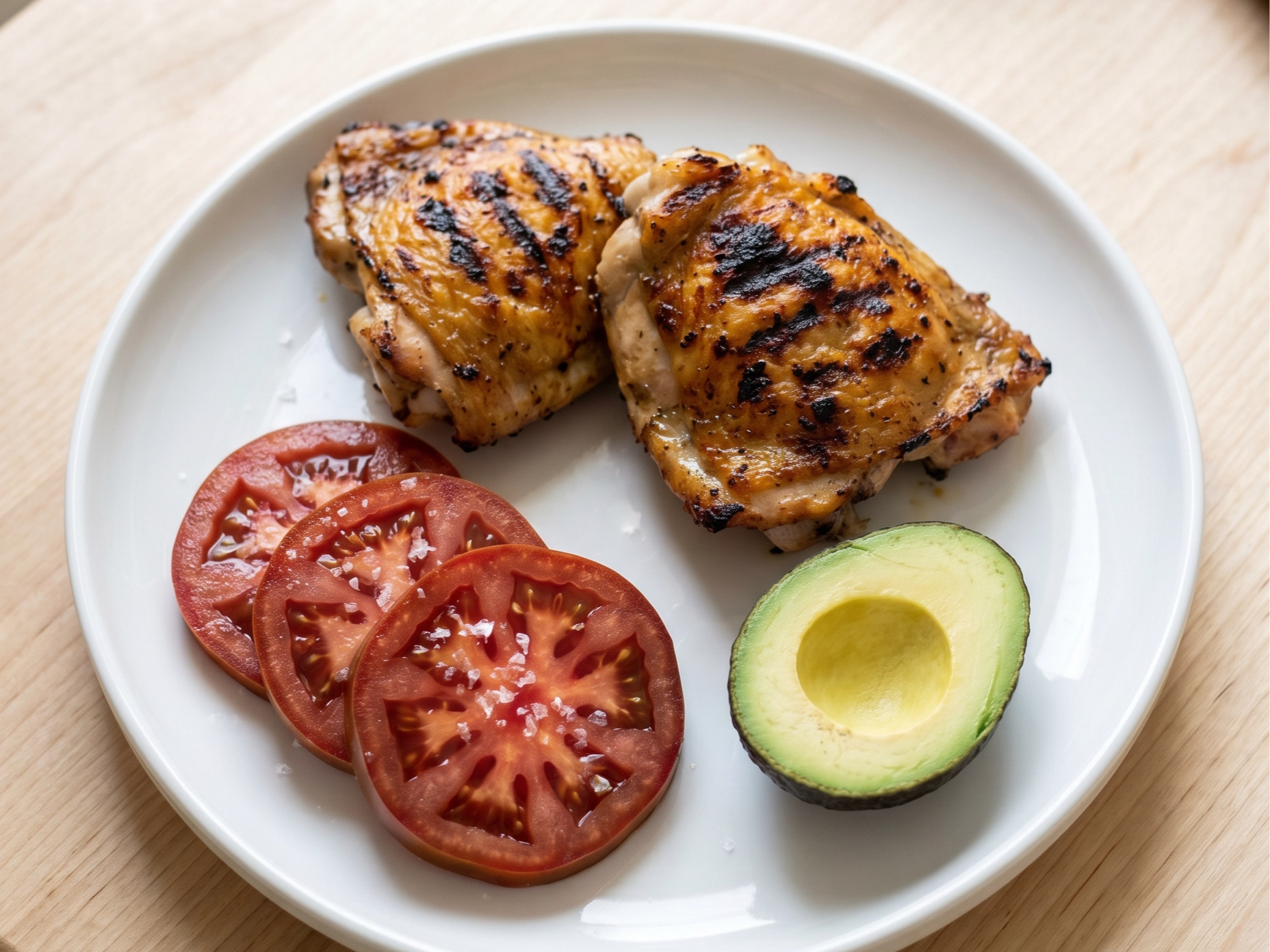
This doesn't mean your food tastes bad. It means your food doesn't need to be a sensory fireworks show to be satisfying. A well-seasoned chicken thigh with roasted carrots and half an avocado is genuinely enjoyable. It's just not engineered to make you eat past the point of fullness.
What These Meals Actually Look Like
Here's the thing that surprises people: boring doesn't mean bland. The meals my most consistent clients eat are built from single-ingredient, whole foods that taste great on their own.
Chicken thighs. Flank steak. Roasted sweet potatoes. Ripe tomatoes with salt. Sautéed broccoli. Macadamia nuts. Avocado. Wild-caught salmon. Scrambled eggs.
Notice what's missing? Sauces with 14 ingredients. Complex recipes that require specialty items. Meals that took longer to cook than to eat.
These are foods that need nothing more than salt, pepper, olive oil, and maybe some garlic. They're nutritionally dense, easy to prep in bulk, and — critically — they don't trigger the kind of "just one more bite" response that hyper-palatable, multi-sensory meals do.
The Contrarian Truth
The wellness industry has an obsession with novelty. New superfoods. New recipes. New meal plans every week. Social media is flooded with "What I Eat in a Day" content that features twelve different meals, all beautifully plated, all wildly impractical for a normal human being with a job.
Meanwhile, the people getting real results are quietly eating their fourth rotisserie chicken of the week and wondering what all the fuss is about.
I'm not saying you should never try a new restaurant or cook something adventurous on a Saturday night. Variety has its place — for enjoyment, for social connection, for making sure you're covering your micronutrient bases over time.
But if you're struggling with consistency? If every week feels like you're starting over because last week's meal plan was too complicated to sustain?
Simplify. Pick five or six meals you like well enough, that are easy to make, and that you can tell me the calorie and protein count of without pulling out your phone. Rotate them. Get efficient at prepping them. Let the boredom work for you instead of fighting against it.
Your nutrition doesn't need to be exciting. It needs to be repeatable.