
Why Your "Normal" Testosterone Test Might Be Lying to You
In April 2026, the FDA signaled a notable shift in how it thinks about testosterone therapy. The agency announced it's encouraging drug makers to pursue a potential new indication for testosterone replacement therapy: treating low libido in men with idiopathic hypogonadism—low testosterone without an identifiable cause. Up to now, FDA-approved TRT products have been indicated only for men with specific forms of hypogonadism tied to known structural or genetic causes.
That's a meaningful change. It means the conversation around testosterone is widening to include men who feel terrible but don't have an obvious medical explanation for it—and that describes a lot of guys walking around right now. But it also raises a question worth sitting with: if a man has low testosterone "without a known cause," does that mean there genuinely isn't one? Or does it mean nobody looked hard enough?
That distinction is the entire point of this article.
The Diagnostic Threshold Problem
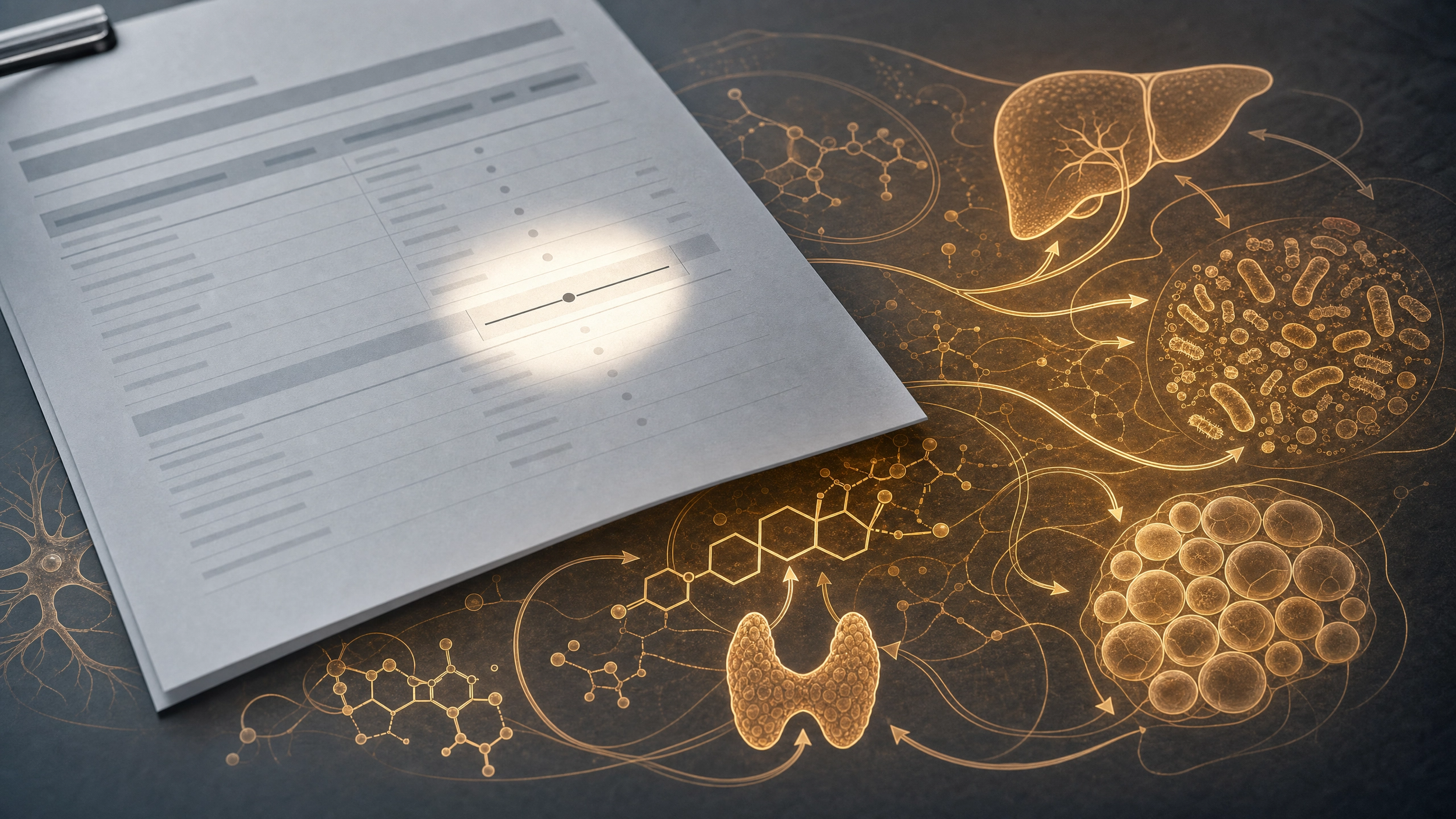
You've been dragging through workouts, struggling with stubborn belly fat, watching your motivation flatline. You finally ask your doctor to check your testosterone. The result comes back "normal." You leave the office no closer to answers than when you walked in.
Here's the problem: that single number on your lab report is telling you maybe a quarter of the story.
Most physicians follow a simple rule: if your total testosterone is below 300 ng/dL on two morning tests and you have symptoms, you qualify for testosterone replacement therapy. Anything above that number? You're "fine."
But "fine" is doing a lot of heavy lifting in that sentence. A 42-year-old with a total testosterone of 380 ng/dL is technically normal—and technically miserable. He may have declining free testosterone, rising inflammation, early insulin resistance, and a body that no longer responds to the same diet and training that worked five years ago. The lab says he's healthy. His life says otherwise.
Functional medicine doesn't accept "above the cutoff" as a diagnosis. It looks at the full picture. And "idiopathic"—the medical term for "we don't know why"—is often just an invitation to dig deeper.
A Quick Note on How We Work
At Nicholson Human Performance, we work with a lot of athletes—both men and women—on testosterone and broader hormone optimization. Hormonal health is central to performance, recovery, body composition, and how you actually feel day to day.
But here's our approach, and it's worth being upfront about it: we optimize first through holistic methods before going the pharmaceutical route. TRT and hormone replacement are real tools with a real place. They're just rarely the right first move. More often, low or imbalanced hormones are a downstream symptom of something fixable. So before anyone talks about a prescription, we want to understand the whole system.
To understand that system, you have to understand what your lab numbers actually mean.
Total, Free, and Bioavailable: Why the Distinction Matters
Testosterone in your bloodstream comes in three forms, and only one of them is actually doing the work. And yes—this matters for women too. Testosterone is a critical hormone for female strength, libido, mood, and body composition; it's just present in smaller amounts.
Total testosterone is everything—all the testosterone floating around in your blood. The problem? Most of it is bound to proteins and unavailable to your tissues. Measuring total testosterone is like checking how much money is in everyone's wallet at a coffee shop and concluding you can afford a latte.
Free testosterone is the small fraction that's completely unbound and ready to bind to receptors in your muscles, brain, and reproductive tissues. This is the testosterone actually doing what testosterone does—building muscle, sharpening focus, driving libido, maintaining bone density.
Bioavailable testosterone is free testosterone plus the portion loosely bound to albumin (a blood protein that releases its grip easily). It's the broader pool of testosterone your body can actually access.
Here's why this matters: a person can have a perfectly respectable total testosterone reading while their free testosterone tells a completely different story. If too much of that testosterone is locked up by binding proteins, the body operates as though it's deficient—because functionally, it is.
Enter SHBG: The Hormone Traffic Cop
Sex hormone binding globulin (SHBG) is a protein your liver produces that binds tightly to testosterone—and to estrogen—and pulls them out of circulation. Think of SHBG as a strict warehouse manager—the more hormone it locks away, the less is available for your tissues to use.
When SHBG runs high, free testosterone runs low—even if total testosterone looks great on paper. This is the missing piece most conventional panels skip entirely.
So what drives SHBG up? Two big culprits: estrogen dominance and liver dysfunction.
The Estrogen-Liver-SHBG Loop
This is where things get interesting, and where most people get stuck without realizing it.
Estrogen tells the liver to produce more SHBG. So when estrogen levels climb, SHBG climbs with it, and free testosterone gets squeezed out. Now, why would someone have elevated estrogen?
Body composition is the biggest driver. Adipose tissue—particularly visceral fat around the midsection—contains an enzyme called aromatase that converts testosterone into estrogen. The more body fat a person carries, the more testosterone gets converted into estrogen, which then drives SHBG up, which then reduces available testosterone further. It's a self-reinforcing cycle that gets worse the longer it runs.
Liver function is the other half of the equation. Your liver is responsible for clearing estrogen from your body. If it's overwhelmed by alcohol, processed foods, environmental toxins, or just chronically inflamed from a poor diet, it can't keep up with estrogen clearance. Estrogen accumulates. SHBG rises. Free testosterone drops.
And here's the kicker—your standard liver enzymes (ALT, AST) can look perfectly normal while your liver is still sluggish at processing estrogen. The liver isn't damaged. It's just overworked and underperforming. SHBG itself becomes a useful proxy: if it's elevated and your enzymes look fine, you're likely seeing impaired estrogen clearance without overt liver damage.
Why This Matters for Women, Too
Everything above isn't a men's-only story. Estrogen clearance, liver health, and gut health are foundational to hormonal balance in women—arguably even more so, because the female hormonal system is more sensitive to small shifts.
When a woman's liver clears estrogen efficiently and her gut isn't recycling it back into circulation, estrogen and progesterone stay in better proportion. That balance influences menstrual cycle regularity, PMS severity, mood stability, energy, and how the body handles the transition through perimenopause and menopause. Poor estrogen clearance, on the other hand, can tip a woman toward estrogen dominance—contributing to heavy or irregular cycles, stubborn fat gain, breast tenderness, low mood, and disrupted sleep.
The same levers that help men—reducing visceral fat, supporting the liver, cleaning up the gut, managing stress, and dialing in thyroid function—directly improve hormonal balance for women. A well-functioning liver and a healthy gut are non-negotiable foundations for hormonal health, regardless of sex. The mechanisms are shared; only the downstream symptoms look different.
The Gut Connection Nobody Talks About
Your gut microbiome plays a surprisingly large role in estrogen levels for everyone. After the liver conjugates estrogen for excretion, it gets dumped into the gut. A healthy microbiome ushers it out of the body. A dysbiotic microbiome contains bacteria that reactivate the conjugated estrogen, allowing it to be reabsorbed back into circulation.
Constipation, low fiber intake, antibiotic overuse, and poor microbiome diversity can all contribute to estrogen recycling. So can a diet low in cruciferous vegetables. You can have a liver doing its job and still end up with elevated estrogen because your gut is sending it back into circulation.
What Actually Moves the Needle
Before you start on testosterone or hormone replacement, here's what we ask you to address first—because those interventions don't fix any of the underlying problems. In fact, they can mask them.
Body composition. Reducing visceral fat reduces aromatase activity, which reduces estrogen production at the source. Resistance training is non-negotiable. It builds muscle, improves insulin sensitivity, and consistently lowers SHBG over time.
Liver support. Cruciferous vegetables—broccoli, Brussels sprouts, cabbage, kale—support the liver's detoxification pathways and help process estrogen for excretion. Cutting alcohol, even moderately, gives the liver significant breathing room. Supplements like milk thistle, NAC, and glycine support liver function, though the foundation has to come from diet first.
Gut health. Fiber, fermented foods, and a diverse plant-based diet feed beneficial gut bacteria and improve estrogen clearance. Addressing constipation is critical. Estrogen that doesn't leave the body via the bowel ends up back in circulation.
Sleep. Poor sleep tanks both hormone production and liver detoxification capacity. Most people trying to optimize their hormones are losing the war in bed before they ever set foot in a gym. Seven to nine hours, consistently.
Stress management. Chronic cortisol elevation impairs estrogen clearance and suppresses healthy hormone production directly. Without addressing this, every other intervention fights against a stacked deck.
Thyroid function. Hypothyroidism slows liver detoxification and worsens estrogen dominance. A complete thyroid panel—not just TSH—should be part of any hormone workup, for men and women alike.
The Bigger Question
TRT and hormone replacement have their place. For people with genuinely low or imbalanced hormones after addressing root causes, they can be life-changing. But starting down that road without first understanding why hormones are off means accepting a long-term prescription to treat a symptom of a deeper problem—and in the case of TRT, once the body adapts to exogenous testosterone, natural production shuts down. There's no easy off-ramp.
The functional medicine question isn't "Are your levels low enough to qualify for treatment?" It's "Why are your hormones off, and what can we fix before we start replacing them?"
If your only data point is a total testosterone number, you don't have enough information to answer that question. You need free testosterone, SHBG, estrogen, a complete thyroid panel, liver markers, inflammatory markers, and fasting insulin—at minimum—to understand what's actually happening.
This Is Complicated, We Made It Simple
If you read this far and thought, that's a lot of interlocking systems to manage—you're right. Body composition feeds estrogen, estrogen drives SHBG, the liver and gut control clearance, and thyroid and stress sit underneath all of it. Pulling one lever moves three others.
That complexity is exactly why we built the Holistic Transformation Program. It's a step-by-step guide that takes the guesswork out of optimizing your health and fitness—including hormonal health, for both men and women. Instead of trying to assemble all of this on your own, you get a clear, sequenced path: what to test, what to address first, and how to actually move the needle in the right order.
Get the full picture. Address the foundation. Then, if hormone therapy is still the right call, you'll be making that decision from a position of knowledge instead of guesswork.
Ready to find out what your numbers are actually telling you?
If you're tired of guessing—or tired of being told you're "fine" when you don't feel fine—let's talk. Book a call and we'll map out what's really going on with your hormones, your labs, and your performance.