
Lose the Fat First. Then Build the Muscle. Here's Why.
You've been told you can do both at once. That's technically true — and practically terrible advice.
Let me save you months of spinning your wheels.
If you're carrying extra body fat and you want to look better, feel better, and actually build a body you're proud of — there's an order of operations that works. And no, it's not "just eat clean and lift heavy and hope for the best."
It's this: Lose the fat first. Then shift your focus to building muscle.
I know that's not the sexy "have it all" answer. But it's the one that actually gets results. Here's why.
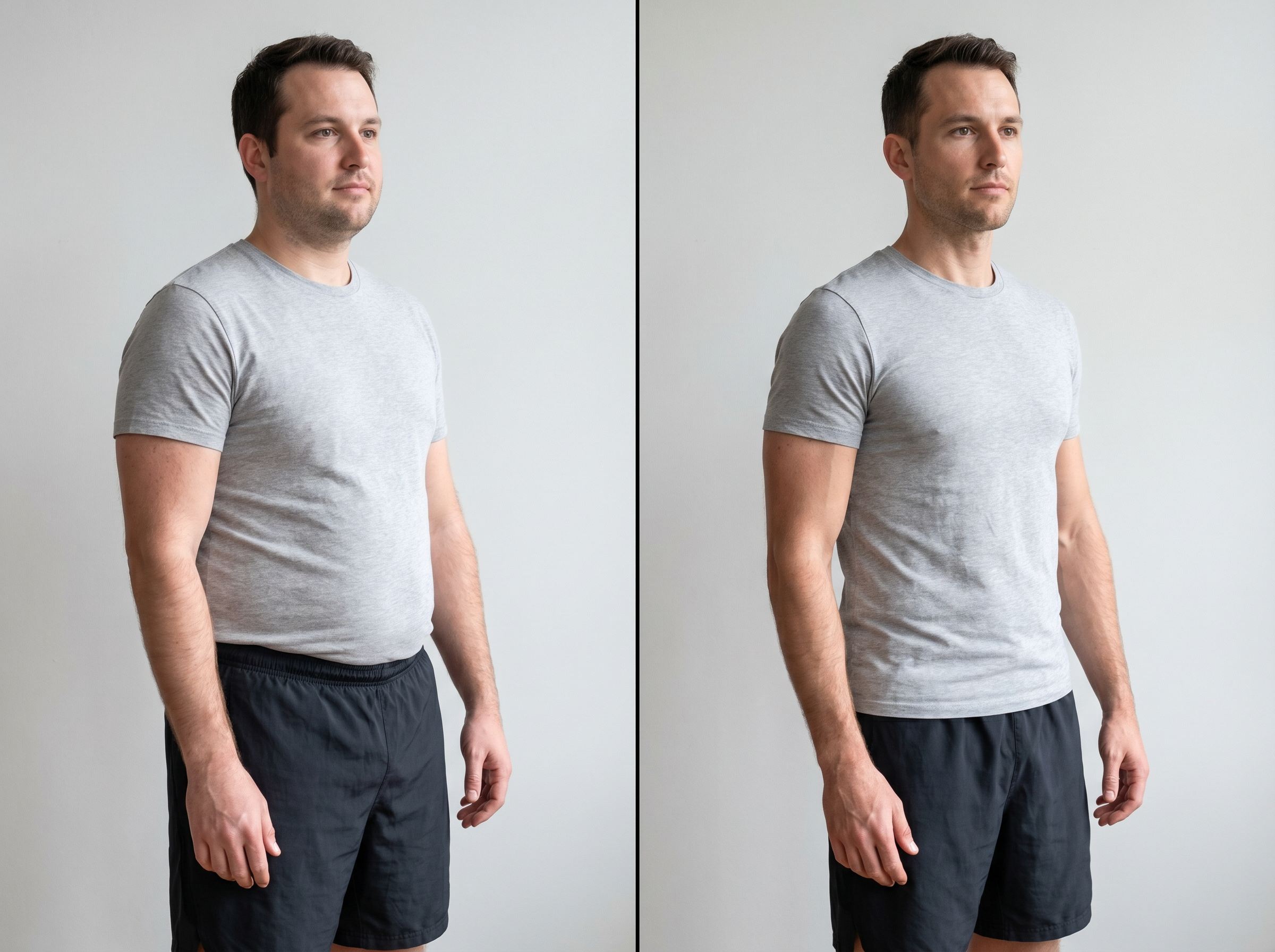
Fat Loss Is Fast. Muscle Gain Is Painfully Slow.
This is the part nobody wants to hear.
A well-structured fat loss phase can produce visible, measurable results in weeks. Research consistently supports that a safe, sustainable rate of fat loss is about 1 to 2 pounds per week (up to about 1% of bodyweight a week) — sometimes more in the early stages for people carrying significant excess weight. That's 8 to 16 pounds in two months. You'll see it. Your clothes will fit differently. People will notice.
Now compare that to muscle gain.
Beginners — the people who build muscle the fastest — can expect roughly 1 to 2 pounds of muscle per month under ideal conditions. Intermediate lifters? Maybe half a pound to a pound. Advanced trainees with several years of lifting under their belts? They're looking at as little as a quarter pound per month.
Read that again. A quarter pound of muscle in a month.
So when someone says "I want to lose fat and gain muscle at the same time," what they're really signing up for is the slowest version of both processes happening simultaneously. You'll barely see the fat come off. You'll barely see the muscle appear. And after three months of grinding, you'll look in the mirror and wonder what you've been doing wrong.
You haven't been doing anything wrong. You've just been fighting biology.
Your Body Builds Muscle Better When You're Already Lean
This is the part most people — and a lot of trainers — completely overlook.
Your body fat percentage directly influences something called nutrient partitioning — essentially, where the calories you eat end up. Do they feed your muscles? Or do they get stored as more fat?
Here's the short version: when you're leaner, your body is more insulin sensitive. Skeletal muscle is responsible for roughly 60 to 70 percent of the body's total insulin-stimulated glucose uptake. When insulin sensitivity is high, your muscles are better at absorbing the nutrients you eat — amino acids, glucose, everything they need to grow. When it's low (which happens at higher body fat levels), more of what you eat gets shuttled into fat storage instead.
Research published in the Journal of Clinical Endocrinology & Metabolism has shown that relative muscle mass is inversely associated with insulin resistance. In plain English: the leaner you are, the better your body uses what you eat to build and maintain muscle.
So when someone who's 30 percent body fat tries to "bulk" and gain muscle, they're fighting an uphill battle. A significant portion of the extra calories they eat to fuel muscle growth gets diverted to fat cells instead. They end up fatter with marginal muscle gains to show for it.
But someone who drops to a leaner starting point first? Their body is primed to build. The same surplus of calories produces a higher ratio of muscle to fat gain. It's not a small difference — it's the difference between a productive training phase and a frustrating one.
Body Recomposition Is Real — But It's Not For Everyone
Let me be fair. Losing fat and gaining muscle at the same time — called "body recomposition" — is absolutely possible. Research in the Strength and Conditioning Journal has confirmed that even trained individuals can achieve it under the right conditions.
But here's what the research also tells us: it works best for specific groups. Beginners who are new to resistance training are essentially in a state where almost any stimulus produces adaptation. Their bodies are so primed for change that they can pull stored energy from fat while simultaneously building new muscle tissue.
For everyone else? It's a grind.
Body recomposition is, by definition, a slower strategy than tackling fat loss or muscle gain individually. You're splitting your body's resources between two competing goals. And as you get more experienced with training, the window for simultaneous progress narrows dramatically.
If you've been lifting for a year or more and you're not significantly overweight, trying to recomp is like driving with one foot on the gas and one on the brake. You'll move, technically. But you won't like the pace.
The Psychological Advantage Nobody Talks About
Here's something that doesn't show up in the research but matters just as much: momentum.
When you commit to a focused fat loss phase first, you see results quickly. Your face changes. Your waistline shrinks. You feel lighter on your feet. Your energy improves. Your sleep gets better. People ask what you've been doing.
That feedback loop is powerful. It builds confidence and buy-in. It proves to you that what you're doing is working.
Now contrast that with a body recomposition approach where you're trying to do everything at once. The scale doesn't move. Your measurements barely change. You might look slightly different after three months, but it's subtle enough that you're not sure if it's real or just lighting.
That uncertainty kills adherence. And adherence is the single most important factor in any fitness outcome.
Get lean, feel the wins, ride the momentum — then pivot to building.
The Health Argument Is Just as Strong
This isn't only about aesthetics. Dropping body fat before focusing on muscle gain has real metabolic advantages.
Excess body fat is associated with chronic low-grade inflammation, disrupted hormone signaling, and impaired metabolic function. Research has linked higher body fat to reduced insulin sensitivity, and poor insulin sensitivity has been associated with greater risk of muscle loss over time. A longitudinal study from the Korean Genome and Epidemiology Study following over 6,000 subjects found that individuals with higher insulin sensitivity had significantly lower risk of losing muscle mass — those in the highest insulin sensitivity group had roughly 35 percent lower risk of muscle loss compared to the lowest group.
By losing fat first, you're not just "looking better to bulk." You're creating a metabolic environment where muscle growth can actually happen efficiently. You're lowering inflammation, improving hormone profiles, and making your body a better machine for building lean tissue.
So What Does This Actually Look Like?
Here's the practical framework:
Phase 1 — Lose the fat. Create a moderate calorie deficit (we aim for 0.5-1.0% of body weight lost per week). Keep protein high — around .8-1.0g per pound of body weight daily. Lift weights and sleep well to preserve muscle mass. Do this for as long as you need to get to an optimal body fat percentage. For men, mid teens, woman low to mid 20s
Phase 2 — Transition. Titrate calories back up by running a reverse diet. Let your metabolism stabilize. Your hormones recalibrate. Your training energy comes back.
Phase 3 — Build the muscle. Shift to a modest calorie surplus (200 to 400 calories above maintenance). Continue high protein intake. Train with progressive overload. Now your body is lean, insulin sensitive, and primed to do exactly what you want it to — grow.
The whole process isn't complicated. But it does require patience and the willingness to focus on one goal at a time.
The Bottom Line
Trying to lose fat and build muscle simultaneously isn't wrong — it's just inefficient for most people beyond the beginner stage.
Fat loss is faster, more visible, and creates the metabolic conditions for better muscle growth down the line. Muscle gain is more successful when your body is already lean, insulin sensitive, and hormonally optimized.
Do the hard thing first. Get lean. Then build on a foundation that's actually ready for it.
Your future, more muscular self will thank you.
Tyler Nicholson is the founder of Nicholson Human Performance, a health and wellness coaching practice based in Centennial, Colorado. If you're ready to stop guessing and start seeing real results, schedule a call and let's build your plan.