
The Air You're Breathing at Night Is Sabotaging Your Sleep
And your Oura ring can't save you from a room full of your own CO2.
I consider myself pretty dialed in when it comes to sleep. Consistent bedtime, cool room, no screens, mouth tape on, Oura ring tracking every stage. By most metrics, I'm getting "good" sleep. Eight hours. Decent HRV. Scores in the green.
So why was I waking up with a foggy head, slow to fire, dragging through the first two hours of the morning like I hadn't slept at all?
I started chasing this down the way I chase everything — with data.
Enter the Aranet4
I picked up an Aranet4 CO2 monitor a few months back. It's a palm-sized device that tracks carbon dioxide levels in real time using a true NDIR (non-dispersive infrared) sensor — the gold standard for accuracy. I'd been using it sporadically at the office and in various rooms around the house, mostly out of curiosity.
Then I started leaving it on the nightstand.
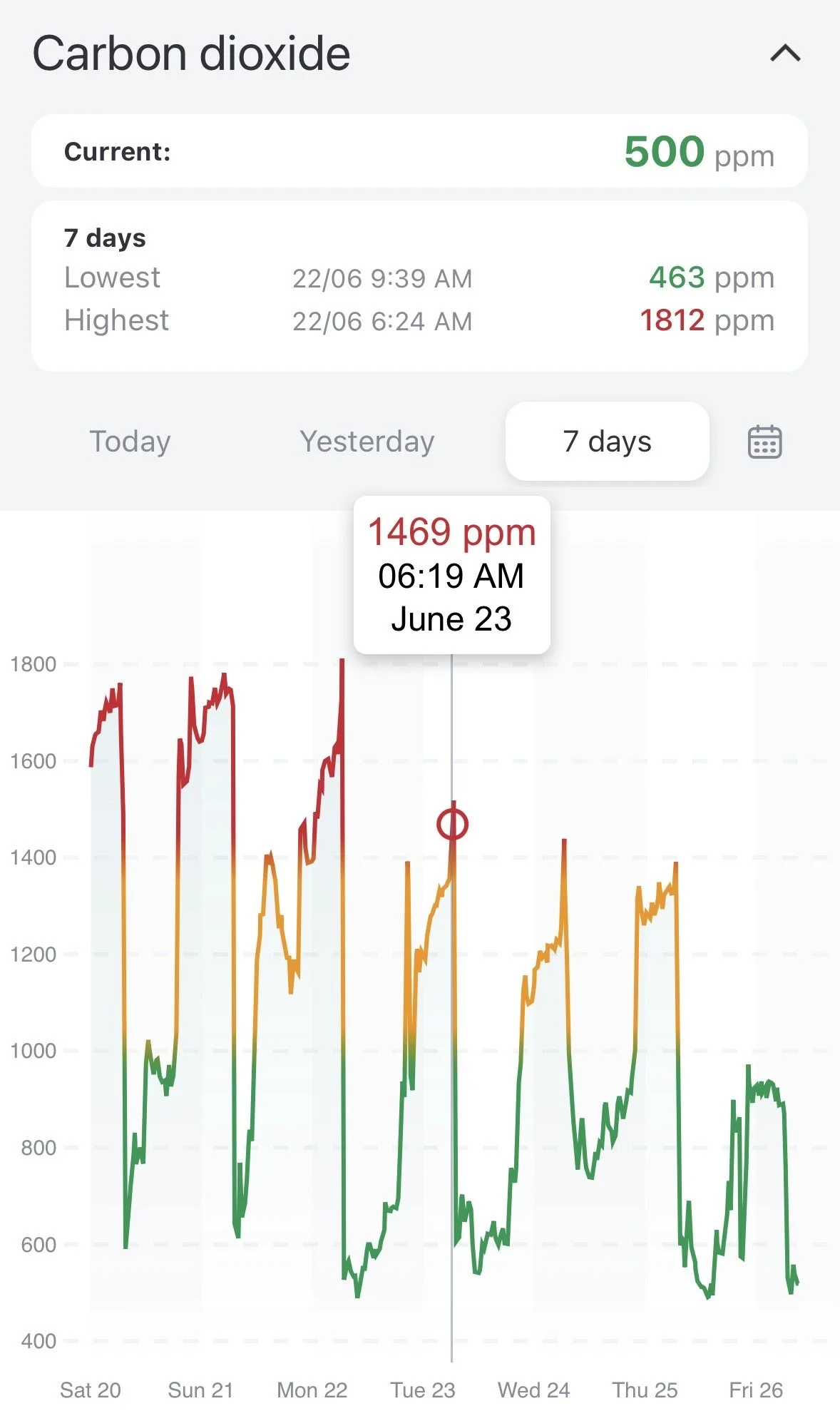
What I found was uncomfortable. Overnight CO2 levels in our bedroom were regularly pushing past 1,800 ppm — sometimes higher. Our bedroom door stays closed. We run a furnace fan.
Here's the basic physiology: every breath you take, your lungs exchange oxygen for carbon dioxide. The CO2 is a waste product of metabolism — your cells produce it, your blood carries it to your lungs, and you off-gas it with every exhale. Do that 15–20 times a minute in a sealed bedroom for eight hours, and the CO2 concentration in the room climbs steadily all night. Two people in a closed room accelerate it even faster. Your bedroom isn't just a sleep space — it's a slow CO2 accumulator.
Here's the thing about 1,800 ppm: it's not harmless.
What CO2 Actually Does to Your Brain
Most people think CO2 is only dangerous because it’s causing global warming. That's not what the research says.
A landmark study found that compared to a 600 ppm baseline, participants showed moderate but statistically significant drops in decision-making performance at just 1,000 ppm. At 2,500 ppm, large and statistically significant reductions showed up on seven out of nine cognitive performance measures. nih
Another more recent meta-analysis confirmed it: complex task performance declined significantly when exposed to CO2 concentrations in the 1,000–1,500 ppm range, and the effects worsened between 1,500 and 3,000 ppm. Prolonged exposure amplifies the adverse effects. ScienceDirect
I was regularly hitting 1,800 while unconscious and supposedly "recovering."
Patrick McKeown — author of The Oxygen Advantage and The Breathing Cure, and one of the most credible voices in breathwork science — has written extensively on what CO2 does to your brain during sleep. His framework makes the mechanism clear: excessive breathing depletes CO2, which causes blood vessels to narrow — reducing blood flow and making it harder to get oxygen to different parts of your body, including the brain. High ambient CO2 in a closed room pushes your body to breathe harder and faster at night, disrupting the deep, slow, efficient breathing that recovery actually requires.
McKeown's research on sleep apnea adds another layer. The brain has chemoreceptors — essentially CO2 sensors — that monitor blood CO2 levels and trigger arousal signals when things get out of balance. Individuals with high sensitivity to CO2 will have an exaggerated physiological response, leading to heavier breathing and frequent arousals from sleep. You might not fully wake up. But you're getting pulled out of deep sleep. That's why your HRV looks fine but your morning feels like garbage.
The Bedroom CO2 Research Is Damning
The sleep science on this is stacking up fast.
A field study on healthy young adults compared sleep quality at three CO2 levels: 750 ppm, 1,000 ppm, and 1,300 ppm. At 1,000 ppm, sleep efficiency dropped and time awake increased by five minutes. At 1,300 ppm, deep sleep duration decreased significantly, and salivary cortisol after waking — a marker of stress and sympathetic activation — went up measurably. The researchers concluded that bedroom CO2 at or above 1,000 ppm should be avoided. ScienceDirect
Read that again. 1,000 ppm. The threshold most people consider "acceptable." Still enough to tank your deep sleep and spike your morning cortisol.
I was sleeping at nearly double that.
Elon Musk caught on to this too — he reportedly keeps a CO2 monitor on his desk that beeps whenever levels rise above 1,000 ppm, noting that his thinking gets hazier above that threshold. I'm not typically in the habit of citing Elon for health protocols, but when the trillionaire and the breathwork researcher agree, it's worth paying attention.
My Trial-and-Error Protocol
Here's where I made a few mistakes worth sharing, because this stuff isn't always intuitive.
First attempt: I set the furnace fan to run on low all night. I figured circulating the air in the bedroom would fix the issue. CO2 dropped somewhat, but not below 1,000 — and I had the timer shut off at 6:00 AM. Problem was, we don't actually get out of bed until 6:30. So I was waking up in the highest-concentration window of the night. Not ideal.
Second attempt: I adjusted the timer. Better, but still couldn't consistently get levels below 1,000 through the full night. The bedroom was still too sealed, and circulating indoor air just moves the same CO2 around.
Current protocol: Before bed, I run the whole house fan for 15–20 minutes to flush the entire house with fresh outdoor air. This is the key step — outdoor air sits at 400–450 ppm, so you're essentially resetting the baseline before you seal the room. Then the furnace fan runs on medium all night to maintain circulation without letting CO2 creep back up unchecked.
The result? I checked the Aranet this morning. CO2 never broke 1,000 ppm all night. I woke up without the fog. Alert. Ready. That's not a coincidence — that's the difference between sleeping in fresh air and sleeping in a CO2 bath.
It Gets Worse When You Travel
Home is a problem you can solve. But if you're on the road and you're not thinking about this, you're giving away sleep every time you check into a hotel.
Research tracking CO2 during real travel found that hotel rooms with just two to three occupants exceeded 800 ppm — the threshold considered suboptimal for ventilation. Airplane cabin CO2 regularly exceeded that same threshold during flight. nih
The average CO2 concentration in an aircraft cabin runs around 1,350 ppm and can reach 3,000 ppm. You land exhausted from a two-hour flight. You thought it was the travel. It was the air. ScienceDirect
Hotel rooms are often worse than planes. Small room, sealed windows, HVAC that recirculates air rather than exchanging it, and sometimes two people. You can easily push 1,500–2,000 ppm overnight without realizing it. The Aranet4 is small enough to throw in your carry-on. I bring mine on every trip now. When I check into a room, I crack a window before bed regardless of temperature. If it's not possible, I run whatever ventilation I can and at minimum open the door to the hallway for 10 minutes before sleeping to reset the CO2 baseline — back toward that 400–450 ppm outdoor air standard.
The Action Plan
If you're doing everything "right" — training, eating well, hitting your sleep hours — and still waking up not quite right, check your air before you blame your program. Here's how:
Get an Aranet4. It's the gold standard consumer CO2 monitor. Amazon Prime Day deal is live right now — grab it while it's on sale.
Leave it on your nightstand with the bedroom door closed. Check the morning history.
Target below 1000 ppm overnight. Under 750 is ideal.
Flush before bed. Open windows or run a whole-house fan for 15–20 minutes. You're pulling in 400–450 ppm outdoor air to displace the accumulated indoor CO2 before you seal everything up for the night. If the weather is right, keep the windows open all night.
Keep air moving. Furnace fan on medium through the night. Even a small window crack can make a dramatic difference — one study found that cracking a bedroom window by just an inch or two dropped CO2 from 2,400 ppm to under 1,000 ppm by 3 AM in a typical bedroom. Mattress Nut
Travel with it. Crack the hotel room window before bed. Don't assume the HVAC is handling it — it's usually not.
The Invisible Variable
Most people optimizing their sleep are laser-focused on supplements, sleep scores, mattresses, and temperature — and completely ignoring the air they're breathing for eight hours straight.
You can have a perfect sleep protocol and still be slowly suffocating yourself on your own exhaled CO2 every night. The data was right there. I just hadn't measured it.
Now I have. And the mornings are different.
If you want to close the gap between how hard you're working and what you're actually getting back — in sleep, in performance, in how you show up — that's exactly what we build at NHP. Book a consultation at nicholsonhp.com and let's look at the full picture.