
The Great American Potato Chip: Guilty Pleasure or Just Misunderstood?
It's July 4th weekend. There's a bag of chips on the table next to the potato salad, and somewhere in your brain a tiny voice is whispering these are bad for you.
Are they, though?
Not always. Not automatically. The potato chip has been lumped into the same "junk food" bucket as gas station donuts and gummy worms for so long that nobody bothers asking what's actually in the bag anymore. Turns out the answer matters. A lot.
Let's break down when chips are a problem, when they're not, and how to eat them like someone who actually knows what they're doing
It's Not the Potato. It's What It's Swimming In.
A potato, sliced thin and fried, is not the enemy. It's a starchy vegetable. The issue is almost never the potato — it's the oil it got dunked in.
Most mass-market chips are fried in seed and vegetable oils — soybean, canola, sunflower, corn. These oils are high in linoleic acid, an omega-6 fat that's unstable at high heat and, for a lot of people, associated with more inflammation in the body. Fry that oil at high temperatures, let it sit on a shelf for months, and you've got a snack that's fighting your body instead of fueling it.
Chips fried in avocado oil or beef tallow are a different animal. Both are far more heat-stable, meaning they don't break down and oxidize the same way seed oils do under the fryer. Less oxidative stress, less gut inflammation, same crunch.
Same potato. Same salt. Completely different fat delivery system. That distinction is the whole ballgame.
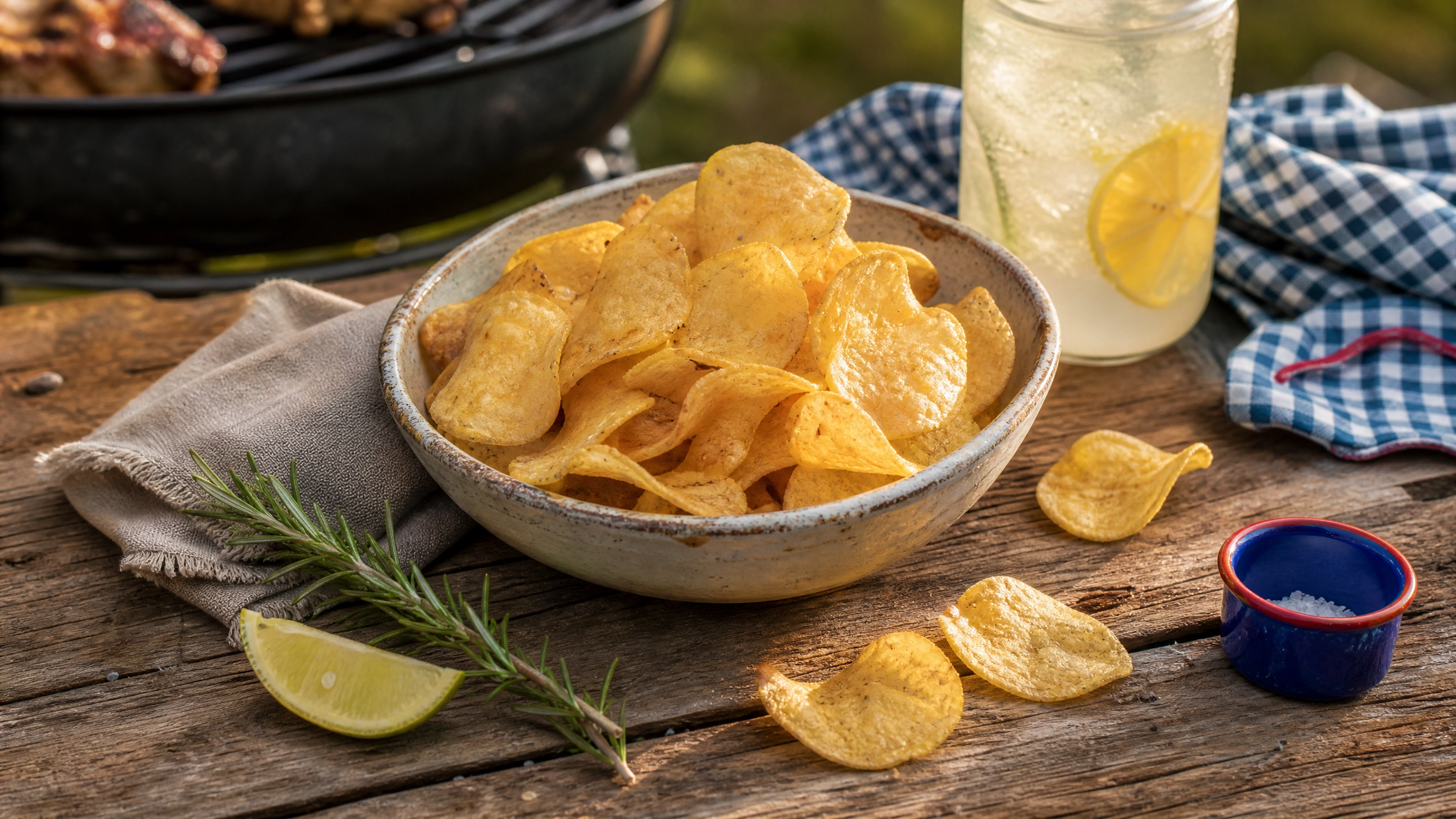
Read Past the First Three Ingredients
Here's where most people stop paying attention — right after they've confirmed it says "potato chips" on the bag.
Keep reading. The ingredient list is where flavored chips get sneaky. Once you get past potatoes, oil, and salt, a lot of brands start adding sugar, maltodextrin, "natural flavors" that are doing a lot of unexplained work, and a handful of things that sound like they belong in a chemistry set, not a snack bowl.
The standard to hold a bag to is simple: potatoes (or sweet potatoes), a stable fat like avocado oil or beef tallow, and seasoning — salt, pepper, maybe some herbs. That's it. That's a clean chip.
Anything past that list, get skeptical. Not because one weird ingredient is going to wreck your Fourth of July — it won't — but because it's usually a sign the whole product was engineered for shelf life and addictiveness, not for you.
Brands like Boulder Canyon and Jackson's make clean versions of this. But — and this matters — they also make flavored, sugar-and-additive-loaded versions sitting right next to the clean ones on the same shelf. Same logo, different product. Read the bag every time. Don't assume the brand name is a blanket pass.
Okay, the Ingredients Are Clean. Now What?
Let's say you did the work. Avocado oil, salt, potato. Nothing sketchy on the label. Are you in the clear?
Mostly — but there's still a math problem to solve, and it's about calories, not toxins.
From a macronutrient standpoint, chips are pure fat and carbohydrate. No protein to speak of. And that matters more than people realize, because protein and carbs/fats play very different roles in your body. Protein is a building block — it goes toward repairing and building the structures that make up muscle, tissue, and cellular machinery. Carbs and fat are fuel. They get burned for energy or they get stored.
Take in more fuel than you burn, and your body does exactly what it's designed to do: store the surplus. Doesn't matter how clean the oil was. A calorie surplus from beautiful, artisanal, seed-oil-free chips still shows up the same way a calorie surplus from anything else does.
So the ingredient question and the quantity question are two separate conversations. You have to win both.
The Bag Doesn't Want You to Stop
Here's the part that's not your fault: chips are engineered — even the clean ones, by nature of the format — to be very hard to stop eating.
Salt, fat, and carbs together hit a combination that appears to blunt your brain's normal satiety signaling. Individually, each of these can drive us to eat more. Stack all three at once — which is exactly what a potato chip is — and you can plow through a genuinely large number of calories before your body sends the "okay, that's enough" signal. That's not weak willpower. That's the product doing exactly what a crunchy, salty, fatty food does to a human brain.
Which is exactly why "just have a few" is bad advice. Nobody has a few. You have a few, then you're methodically checking the bag for structural integrity by hand, and forty-five minutes later it's empty and you don't remember agreeing to that.
The Actual Fix (It's Not Willpower)
You're not going to out-discipline a bag of chips at a July 4th cookout. Nobody has. Don't try.
Instead, take the decision out of the moment entirely:
Weigh out a real serving in a bowl before you start eating, based on what your day's fuel needs actually look like. For most people, that's about 1–2 ounces. Put the chips in a bowl, put the bag away — not just "on the other side of the table," actually away — and eat from the bowl. When the bowl's empty, you're done deciding. You already decided, back when your brain was still in charge.
This one move solves the satiety-override problem without requiring you to have more self-control than the rest of the country trying to enjoy a barbecue.
So — Can You Actually Eat Chips and Still Be Healthy?
Yes. Genuinely, yes. Just not mindlessly, and not straight out of the bag.
Check the ingredients. Potato, stable fat (avocado oil or tallow), salt — good. A paragraph of stuff you can't pronounce — skip it, or at least know what you're signing up for. Once the ingredients pass, portion your serving like you actually plan on eating dinner too. That's the whole system.
Nobody's saying skip the chips this weekend. Just stop treating the bag like it's got a bottom you'll never reach. It doesn't. That's kind of the point.
Happy Fourth. Go enjoy the potato salad too — that's a conversation for another day.
Precision isn't about restriction — it's about knowing exactly what you're working with, down to the ingredient label. That's the whole philosophy behind the Holistic Transformation Program. If you want that kind of clarity applied to your whole plate, not just the chip bowl —
Book your free High Touch Performance Consultation →
Tyler Nicholson | Nicholson Human Performance | nicholsonhp.com